
What Is Broker Management Software? Features, Benefits, and How to Choose the Right Platform

What is broker management software, and who needs it?
Broker management software (BMS) is a platform that centralises how real estate companies run their broker networks — onboarding, inventory distribution, commission tracking, compliance monitoring, and performance reporting in one system. Developers, brokerage firms, and agent teams use it to replace spreadsheets, email chains, and WhatsApp groups with structured, auditable workflows.
If you work in real estate — whether as a developer, a brokerage firm, or a broker managing a team of agents — you already know how many moving parts are involved. Leads, listings, client interactions, deal pipelines, commission calculations, compliance checks, and document management all compete for your attention simultaneously.
For years, the industry managed these workflows through spreadsheets, email chains, WhatsApp groups, and disconnected portals. That approach worked when volumes were manageable. It does not work when you are coordinating dozens or hundreds of brokers across multiple projects in a market that processed AED 682.5 billion in transactions in 2025.
Broker management software (BMS) brings all of these operations into a single platform — giving developers, brokerages, and agents the tools to manage the entire broker lifecycle from onboarding to commissions without the friction of manual coordination.
In this guide, we will cover what broker management software is, who uses it, the features that matter, the benefits it delivers, how the market is evolving, and what to look for when choosing the right platform.
What Is Broker Management Software?
Broker management software is a specialised platform designed to manage the operational relationship between real estate companies and their broker networks. It centralises the workflows that drive broker-assisted sales and leasing — onboarding, inventory distribution, commission tracking, compliance monitoring, document management, and performance reporting.
Unlike generic CRM systems that treat brokers as another contact type, purpose-built BMS platforms are designed around the specific multi-party workflows that real estate broker operations require. A developer releasing off-plan units needs a different system than a SaaS company tracking sales leads.
The Market Behind the Growth
The real estate brokerage software market was valued at $2.78 billion in 2024 and is projected to reach $5.92 billion by 2033, growing at a compound annual growth rate of 9.1%. Several factors are driving this:
- Digital transformation across the real estate industry is replacing paper-based workflows with structured platforms
- Online property transactions are increasing as buyers and brokers expect digital-first experiences
- AI and data analytics are moving from buzzword to production, providing actionable insights on broker performance and market trends
- Cloud adoption is making broker management software more accessible, scalable, and affordable
- Remote and mobile work demands tools that work from anywhere, not just the back office
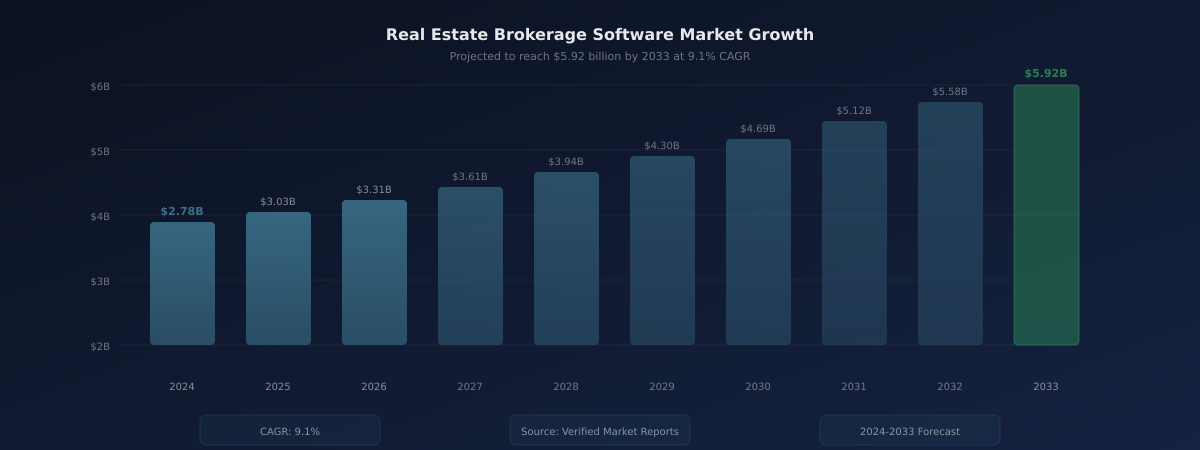 The broker management software market is projected to more than double in the next decade
Who Uses Broker Management Software?
Despite the name, broker management software is not just for brokers. It serves the entire ecosystem of professionals involved in real estate transactions.
Property Developers
For developers — especially those managing off-plan projects with large broker networks — BMS is the operational control centre for sales. Project managers, sales directors, leasing managers, and operations teams use it to manage unit releases, broker onboarding, commission rules, and deal visibility. In markets like the UAE, where developers routinely work with 100-500+ brokers per project, this is not optional.
Brokerage Firms
Brokerage firms and agency companies use BMS to manage their agent rosters, track deal pipelines across multiple developers, monitor commission receivables, ensure licence compliance, and report on agent performance. For firms managing dozens of agents across residential and commercial portfolios, a centralised system prevents the chaos that comes from spreadsheet-based operations.
Individual Broker Agents
Individual agents benefit from BMS through better access to live inventory, real-time commission visibility, streamlined document uploads, and faster responses from developer sales teams. When a broker can check unit availability and commission status without sending a WhatsApp message and waiting for a reply, their selling speed increases significantly.
Internal Sales Teams
Developer in-house sales teams use BMS alongside external brokers — managing lead handoffs, tracking which units are allocated to which channels, and ensuring internal and external agents are not duplicating efforts or working from different data.
The most effective broker management platforms serve both sides — giving developers operational control while giving brokers the tools and visibility to sell faster. One-sided platforms create friction rather than reducing it.
Key Features of Broker Management Software
When evaluating broker management software, these are the capabilities that separate useful platforms from generic tools with a real estate skin.
Broker Onboarding and Profile Management
The platform should handle the full broker registration lifecycle — from initial sign-up and document submission to verification, approval, and access provisioning. Each broker profile should store licensing information, company details, performance history, and compliance status in one place. For a deeper look at what broker onboarding involves, see our post on real estate broker management software.
Real-Time Inventory Distribution
When a developer releases units, changes pricing, or updates payment plans, every broker in the network should see those changes instantly. No PDF price lists. No WhatsApp broadcasts. A live feed that reflects the current state of the developer's inventory at all times.
Commission Tracking and Automation
Commission structures in real estate are rarely simple. They vary by project, phase, broker tier, deal value, and payment milestone. BMS should automate these calculations, provide brokers with real-time payout visibility, and give developers clear commission liability reporting.
Compliance and Licence Monitoring
In regulated markets like the UAE, the platform must track RERA registrations, trade licence expiry dates, agency agreement statuses, and DLD documentation requirements. Automated alerts should notify both developers and brokers before deadlines pass. For the document management dimension, see our article on real estate document management software.
Lead Management and Distribution
Automated lead assignment ensures brokers receive opportunities matched to their expertise, geography, or performance tier. Lead tracking gives developers visibility into which brokers are actively working leads and which opportunities are going cold.
Contract and Agreement Management
Built-in tools for generating, tracking, and managing agreements — from broker registration agreements to SPAs to commission letters. Version control, digital signatures, and approval routing reduce the back-and-forth that slows down deals.
Reporting and Analytics
Dashboards that show broker network health, deal pipeline status, commission liabilities, compliance rates, and performance rankings. These insights drive decisions about which brokers to invest in, which projects need more attention, and where operational bottlenecks exist.
Integration Capabilities
BMS should connect with accounting systems, payment gateways, document storage, and marketing platforms. In the UAE, integrations with DLD systems and payment processors are particularly important for end-to-end workflow automation.
Benefits of Using Broker Management Software
The value of BMS is not theoretical. It shows up in measurable operational improvements across every part of the developer-broker relationship.
Elimination of Manual Work
The most immediate benefit is automation. Onboarding workflows that took 7-14 days manually now complete in hours. Commission calculations that required spreadsheet reconciliation happen automatically. Document expiry tracking that depended on someone checking a spreadsheet now runs continuously with automated alerts.
Better Broker Relationships
When brokers have real-time access to inventory, transparent commission tracking, and a self-service portal for documents and communications, they prioritise your projects over developers who still operate through WhatsApp and email. Broker trust is built on operational transparency.
Financial Visibility and Accuracy
Automated commission calculations, payment tracking, and financial reporting eliminate the errors, disputes, and reconciliation delays that come with manual spreadsheet-based management. Developers always know their commission liabilities. Brokers always know their payout status.
In manual operations, commission disputes are not just a finance problem — they are a relationship problem. When a broker loses confidence in how commissions are tracked, they redirect their best buyers to developers with better operational transparency.
360-Degree Operational Visibility
From deal pipelines to agent performance to compliance status, BMS gives leadership teams a complete, real-time view of broker operations. Decisions stop being based on anecdotal feedback and start being based on data — which projects are selling, which brokers are performing, and where bottlenecks exist.
Stronger Compliance Posture
Automated compliance monitoring replaces the manual checks that miss expired licences, outdated agreements, and regulatory changes. In markets like the UAE where RERA and DLD enforcement is active, this is not just convenient — it is necessary.
Faster Deal Velocity
When brokers have live inventory data, instant communication channels, clear commission terms, and structured document workflows, the time from buyer enquiry to reservation drops significantly. Every day saved in the deal cycle is revenue captured sooner.
Cost Reduction
By reducing manual admin work, eliminating paper processes, preventing duplicate efforts, and cutting commission disputes, BMS lowers the operational cost of managing a broker network. Teams can scale broker relationships without proportionally scaling headcount.
Cloud-Based vs. On-Premise: Which Approach Works Better?
Broker management software is available in two primary deployment models, and the right choice depends on your organisation's priorities.
On-Premise BMS
On-premise software is installed on your company's own servers. It gives you maximum control over data, security protocols, and customisation. For organisations with strict data residency requirements or large IT teams, this can be the right fit.
The trade-off is higher upfront cost, slower deployment, and the need for dedicated IT resources to maintain, update, and troubleshoot the system. Scaling typically requires additional hardware investment.
Cloud-Based BMS
Cloud-based platforms are hosted by the vendor and accessed through a web browser. They are faster to deploy, easier to update, and more accessible for distributed teams and field agents. Most modern BMS platforms use this model, running on subscription pricing that scales with your needs.
For real estate companies with brokers and agents working across multiple locations — which is the norm in the UAE — cloud-based deployment is usually the practical choice. Security, backups, and updates are handled by the provider, and mobile access is built in.
How to Choose the Right Broker Management Software
Not every BMS is built the same. Here is what to evaluate before committing to a platform.
1. Alignment with Your Core Workflow
Does the platform match how your business actually operates? A developer managing off-plan broker networks needs different capabilities than a brokerage firm managing agent rosters. Choose software built for your specific use case, not a generic platform that claims to serve everyone.
2. Feature Completeness
Ensure the platform covers the full broker lifecycle — onboarding, inventory, commissions, compliance, documents, and reporting. Gaps in coverage mean you will end up supplementing with spreadsheets, which defeats the purpose.
3. Market-Specific Compliance
For UAE-based operations, the platform must natively support RERA registration tracking, DLD documentation, Form A/B management, and trade licence monitoring. Generic international platforms rarely handle these requirements without significant customisation.
4. Integration Capabilities
The platform should connect with your accounting system, payment gateways, document storage, and any existing CRM or ERP systems. Isolated tools create data silos rather than solving them.
5. Ease of Use
If the platform is too complex for brokers to adopt, it will not deliver value. Self-service portals, intuitive interfaces, and mobile access are essential — especially for external broker agents who will not sit through extensive training sessions.
6. Scalability
Can the platform handle your broker network as it grows from 50 to 500 to 5,000 brokers? Can it support multiple simultaneous project launches? Scalability should be built in, not bolted on.
7. Vendor Track Record
Look for vendors with real estate domain expertise, not generic software companies entering the market. Check for implementations in your market, reference customers, and ongoing product development.
8. Data Security
Real estate transactions involve sensitive financial and personal data. Ensure the platform provides encryption, role-based access, secure hosting, regular backups, and compliance with relevant data protection regulations.
The most important evaluation question is not "what features does this platform have?" It is "was this platform built for how real estate broker operations actually work, or was it adapted from something else?"
A related decision is build versus buy. If your organisation prefers to build on an existing CRM like Salesforce or customise its own solution, AqarWorks specialises in real-estate Salesforce implementations and provides the BRD templates and process diagrams needed to scope that build properly — a practical middle path between buying off the shelf and starting from a blank page.
Market Opportunities and Challenges
The broker management software market is growing rapidly, but it comes with both opportunities and challenges that buyers and vendors should understand.
Opportunities
- AI integration is enabling smarter lead distribution, predictive broker performance analytics, and automated document processing
- Cloud adoption continues to lower barriers to entry and enables rapid deployment across distributed teams
- Regional expansion into high-growth markets like the UAE, Saudi Arabia (Vision 2030), and Southeast Asia is creating demand for localised platforms
- Two-sided platforms that serve both developers and brokers are capturing more value than single-sided tools
Challenges
- High competition among vendors means buyers must evaluate carefully — not every platform that claims BMS capabilities is purpose-built for real estate
- Data security requirements are increasing as regulations tighten and transaction values grow
- Change resistance within organisations makes adoption harder than selection — training and change management are critical
- Integration complexity with existing systems (ERP, accounting, DLD) can slow deployment if the platform is not designed for the local ecosystem
How Nogbase Fits In
Nogbase is built specifically for the developer-to-broker workflow in real estate. Rather than adapting a generic CRM or property management tool, Nogbase was designed from the ground up for the operational reality of how UAE off-plan developers manage broker networks.
The platform covers the full broker lifecycle:
- Onboarding — structured self-service registration with automated document verification and approval workflows
- Inventory sync — real-time unit availability, pricing, and payment plan distribution across the entire broker network
- Commission automation — configurable rules that handle complex commission structures across projects, phases, and broker tiers
- Compliance tracking — automated RERA and trade licence monitoring with proactive expiry alerts
- Document management — centralised storage linked to brokers, transactions, and units with full audit trails
- AI-powered insights — recommendations for both internal sales teams and broker agents to close deals faster
This builds on the broader market trends covered in PropTech UAE 2026 and the industry conversations at PropTech Connect February 2026.
For developers evaluating broker management platforms, our detailed breakdown of what a BMS should do for developers covers the AI layer and internal/external sales alignment in depth.
Final Thought
Broker management software is not a nice-to-have for real estate companies managing broker relationships at scale. It is the operational infrastructure that determines whether your broker network is a controlled, measurable sales channel or a source of daily operational friction.
The right platform should match your specific workflow, cover the full broker lifecycle, support your market's regulatory requirements, and be simple enough for brokers to actually use. The wrong platform — or no platform at all — means spreadsheets, disputes, missed renewals, and lost deals.
If you want to see how Nogbase handles broker management for UAE real estate developers, book a demo.
Related practical guides
Continue with how developers share inventory with selected brokers and how real estate commissions are managed.

Keep Reading

PropTech UAE 2026: How Technology is Reshaping Dubai Real Estate
An overview of how PropTech platforms are transforming developer-broker operations in Dubai's off-plan real estate market in 2026.