
Real Estate Document Management Software: Why Developers Need More Than Shared Drives

Why do real estate developers need document management software?
Real estate document management software gives developers a shared home for every agreement, licence, and transaction file. An off-plan deal can involve identity records, agreements, receipts and broker documents; scattered copies make version control difficult. Purpose-built software stores documents, tracks expiries, controls access, and keeps everything audit-ready.
A single off-plan real estate transaction in the UAE can involve many documents — from buyer passports and reservation forms to SPAs, commission invoices, RERA registrations, and DLD fee receipts. Multiply that by hundreds or thousands of active deals across multiple projects, and the document management challenge becomes clear.
Most real estate developers still manage this volume through a combination of shared network drives, email attachments, WhatsApp file sharing, and physical filing cabinets. Documents get duplicated, misfiled, or lost entirely. When someone needs a specific agreement or licence, the search starts in Outlook, moves to a shared folder, and often ends with a WhatsApp message asking someone to resend it.
Real estate document management software replaces this chaos with a centralised platform where every document — across every project, broker, and transaction — is stored, tracked, and accessible in one place.
Why Real Estate Documents Are Different
Document management in real estate is not the same as general-purpose file storage. Real estate documents carry regulatory weight, have expiry dates, require signatures from multiple parties, and must be retrievable on demand for audits, disputes, or compliance checks. Generic tools like Google Drive or Dropbox are not built for this.
Documents Have Legal and Regulatory Significance
In the UAE, real estate transactions involve documents regulated by RERA, the Dubai Land Department (DLD), and other authorities. Form A (seller-broker agreement), Form B (buyer-broker agreement), Form F (seller-buyer sale contract), and SPAs all have specific legal requirements. Missing, expired, or incorrectly executed versions of these documents can delay transactions, trigger fines, or create legal liability.
Documents Have Expiry Dates
Broker trade licences, RERA registrations, agency agreements, and buyer identity documents all expire. An expired trade licence should trigger a review before new activity is approved. When a buyer's passport copy on file is outdated, KYC compliance is compromised. Tracking these expiry dates manually across hundreds of brokers and thousands of buyers is a recipe for missed renewals and compliance gaps.
Documents Span Multiple Parties
A single transaction involves documents from the developer, the broker, the buyer, and sometimes legal advisors or mortgage providers. Each party uploads, signs, or reviews different documents at different stages. Without a centralised system, version conflicts, missing signatures, and incomplete submissions become routine.
When a compliance audit asks for a specific broker's trade licence renewal or a buyer's signed SPA from 18 months ago, the time it takes to find that document tells you everything about your document management maturity.
The Real Cost of Fragmented Document Management
The consequences of poor document management are not abstract. They show up as concrete operational problems that cost developers time, money, and broker trust.
Delayed Transactions
When a broker submits a reservation and the developer's team cannot locate the broker's signed agency agreement or verified trade licence, the deal stalls. What should be a same-day process turns into a multi-day back-and-forth of document requests, email searches, and re-uploads.
Compliance Exposure
RERA and DLD conduct periodic audits of developer operations. If a developer cannot produce proper documentation for broker registrations, transaction records, or commission agreements within a reasonable timeframe, the regulatory consequences range from warnings to fines to licence suspension.
Commission Disputes
When commission agreements are stored in email threads and WhatsApp conversations rather than a structured system, disputes are inevitable. The broker says one rate was agreed. The developer's records show another. Without a clear, timestamped, version-controlled document trail, resolving these disputes consumes hours of management time and damages broker relationships.
Duplicated Work
Without a single source of truth, different teams within the developer's organisation often maintain their own copies of the same documents. Sales has one version of the payment plan. Marketing has another. The broker portal shows a third. When documents are updated, not every copy gets updated — leading to brokers working with outdated pricing, incorrect floor plans, or superseded agreements.
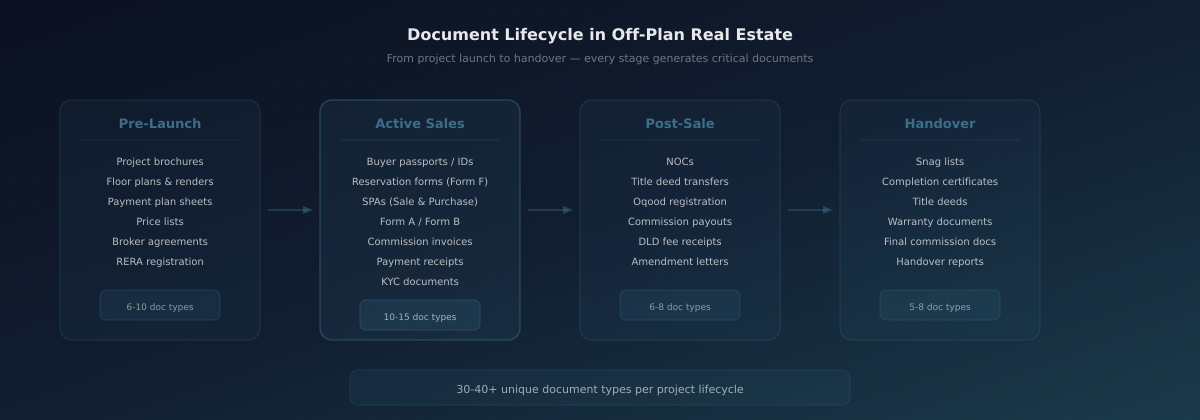 Every phase of an off-plan project generates critical documents that must be tracked and accessible
What Real Estate Document Management Software Should Do
Effective document management in real estate goes well beyond file storage. Here are the capabilities that separate a purpose-built platform from a generic cloud drive.
Centralised Document Storage
All documents — agreements, licences, identity proofs, commission records, project collateral, compliance forms — should live in one system. Every document should be linked to the relevant entity: a specific broker, buyer, unit, project, or transaction. This means when you pull up a broker's profile, you see every document associated with them — not just the ones someone remembered to file correctly.
Automated Expiry Tracking and Alerts
The platform should automatically monitor expiry dates for trade licences, RERA registrations, agency agreements, and identity documents. When a document is approaching its expiry date, the system should notify both the developer's team and the relevant broker or buyer — without anyone having to check a spreadsheet.
Version Control and Audit Trails
Every document action — upload, download, edit, signature, approval, rejection — should be logged with a timestamp and user identity. When a document is updated, the previous version should be preserved and accessible. This creates the audit trail that regulators, legal teams, and compliance officers require.
Role-Based Access Control
Not every user should see every document. Brokers should access their own agreements, commission statements, and project collateral — but not other brokers' documents or internal financial records. Internal sales teams, finance, and legal departments need different levels of access. The platform should enforce these boundaries automatically.
Digital Signatures and Approvals
Document workflows should support electronic signatures, approval routing, and status tracking. When a broker agreement needs the sales director's approval, the system should route it automatically, capture the approval, and notify all relevant parties — without anyone printing, scanning, or emailing PDFs back and forth.
Template-Based Document Generation
Agreements, reservation forms, commission letters, and NOC requests follow standardised formats. The platform should auto-generate these documents from templates, pre-filled with transaction data — buyer name, unit number, payment schedule, commission rate — reducing manual data entry and ensuring consistency across all documents.
Key Document Categories in UAE Real Estate
Understanding what needs to be managed helps evaluate whether a platform is built for real estate or just adapted from a generic solution. Here are the document categories that UAE developers deal with daily.
Broker Onboarding Documents
- Trade licence — must be valid and current; the platform should track expiry
- RERA broker registration — required for all brokers operating in Dubai
- Agency agreement — defines the terms of the developer-broker relationship
- Broker company profile — contact details, specialisations, team size
- Individual agent authorisation — links individual agents to their parent brokerage
Transaction Documents
- Form A — seller-broker agreement (Dubai-specific)
- Form B — buyer-broker agreement
- Form F — seller-buyer sale contract
- SPA (Sale and Purchase Agreement) — the primary contract between buyer and developer
- MOU (Memorandum of Understanding) — preliminary agreement before SPA execution
- Payment receipts — against each milestone in the payment plan
Buyer Identity and KYC Documents
- Passport copies — required for all buyers
- Emirates ID — for UAE residents
- Visa copies — residence visa for non-citizen buyers
- Power of Attorney — when a representative acts on behalf of the buyer
- Source of funds documentation — for AML/KYC compliance
Commission and Financial Documents
- Commission agreement — rate, milestones, and payment terms
- Commission invoice — submitted by broker upon deal milestones
- Payout confirmation — proof of commission payment
- Credit notes and adjustments — for cancelled or modified deals
Compliance and Regulatory Documents
- Oqood registration — DLD registration for off-plan units
- NOC (No Objection Certificate) — required for various transactions
- Title deed — final ownership document
- DLD fee receipts — proof of government fee payments
Define the required document set for each transaction stage, then track missing, expired and superseded records. Volume depends on your projects and operating model.
How Nogbase Handles Document Management
Nogbase is built for the developer-to-broker workflow in UAE real estate, and document management is embedded directly into the platform — not bolted on as an afterthought.
Here is how Nogbase handles the document challenge:
- Centralised document storage linked to brokers, buyers, units, and transactions — every document is contextual, not just filed in a folder
- Automated expiry tracking for trade licences, RERA registrations, and agency agreements with proactive alerts sent to both developers and brokers before deadlines pass
- Broker self-service uploads through the portal — brokers upload their own documents during onboarding and renewals, eliminating the email back-and-forth
- Role-based access so brokers see their documents and project collateral, while developers maintain full visibility across the entire broker network
- Version history and audit trails for every document action, supporting RERA compliance requirements and dispute resolution
- Template-based generation for standard agreements and commission documents, pre-filled with deal data to reduce errors and speed up execution
This document layer works alongside Nogbase's core broker management capabilities — onboarding, inventory sync, and commission tracking — creating a single platform where developers manage every aspect of the broker relationship.
For developers who want to understand the broader operational context, including how AI enhances these workflows, see our post on broker management systems for real estate developers.
If you are scoping a document management rollout yourself and need ready-made starting points — business requirement documents, process diagrams, data dictionaries, and operating playbooks for real estate operations — AqarWorks maintains a template library built specifically for developer and brokerage teams, and offers hands-on help customising these workflows.
Document management is most powerful when it is not a standalone system. When documents live inside the same platform that manages broker onboarding, inventory, and commissions, every document has context — and every workflow has the documentation it needs.
The Business Outcome
Measure the rollout against these intended outcomes:
- Faster transactions — less time spent finding missing or misfiled documents
- Stronger compliance posture — automated tracking replaces manual spreadsheet checks
- Fewer disputes — version-controlled, timestamped documents help resolve ambiguity
- Reduced operational overhead — self-service uploads and automated generation replace manual admin work
- Better broker experience — brokers who can access their documents instantly are more engaged and productive
- Audit readiness — full trails available on demand, not after days of searching
The developers and brokerages reshaping how the UAE market operates are covered in depth in our PropTech UAE 2026 overview and our PropTech Connect February 2026 recap.
Final Thought
If your team spends more than a few minutes finding any document — a broker's trade licence, a buyer's signed SPA, a commission agreement from last quarter — then document management is costing you deals, compliance confidence, and broker trust.
Real estate document management software is not about digitising paper. It is about building the operational foundation that every other workflow — onboarding, sales, commissions, compliance — depends on.
If you want to see how Nogbase centralises document management alongside broker operations, inventory sync, and commission automation, book a demo.
Related practical guides
Use the EOI and reservation guide to map documents to transaction stages, and the payment-plan guide to distinguish schedules, invoices and receipts.
Document requirements depend on the transaction and parties; Forms A, B and F are not a universal checklist for every developer off-plan sale. Software supports document controls and does not establish legal compliance by itself. See the Dubai Land Department user guides and its Contract B guide.

Keep Reading

Real Estate Broker Management Software: Streamlining Onboarding, Compliance, and Commissions
Discover how real estate broker management software helps developers automate broker onboarding, track commissions, ensure RERA compliance, and improve communication across their entire broker network.