
Real Estate Broker Management Software: Streamlining Onboarding, Compliance, and Commissions

Why is broker management a developer's biggest operational blind spot?
Broker management is a blind spot because brokers drive the majority of off-plan revenue, yet most developers still coordinate them through WhatsApp, email, and spreadsheets. Real estate broker management software closes the gap by handling onboarding, RERA compliance, inventory distribution, and commission tracking in one platform — reducing disputes and speeding up broker activation.
For real estate developers, brokers are not just a sales channel — they are the primary revenue engine. In Dubai alone, brokers facilitated the majority of off-plan transactions in 2025, generating AED 13.59 billion in commissions across a market that processed AED 682.5 billion in total sales volume.
Despite that scale, most developers still manage their broker networks through a patchwork of WhatsApp groups, email threads, shared spreadsheets, and disconnected portals. The result is operational friction that slows onboarding, creates compliance gaps, and leads to commission disputes that damage broker relationships.
Real estate broker management software solves this by replacing fragmented manual workflows with a single platform that handles onboarding, compliance, inventory distribution, and commission tracking in one place.
Key Challenges in Broker Management
Before looking at what broker management software should do, it is worth understanding exactly where manual operations break down. These are the pain points that developers deal with daily — and the reasons the market is moving toward purpose-built platforms.
Manual Processes and Inefficiencies
Many real estate developers still rely on spreadsheets, email attachments, and paper forms to manage broker onboarding. A new broker signs up, sends documents via email, someone on the developer's team manually reviews and files them, and access is granted through an informal WhatsApp message. This process is not only time-consuming but error-prone. Documents get lost in email chains, version conflicts go unnoticed, and there is no structured audit trail for who approved what and when.
Difficulty Tracking Broker Information
As a developer scales from 10 to 100 to 500+ active brokers, keeping track of each broker's licensing status, RERA registration, trade license expiry, and performance history becomes unmanageable in spreadsheets. When a broker's trade license expires, there is no automated flag. When a top-performing broker has been inactive for weeks, no one notices until the pipeline stalls.
Fragmented Communication
Without a centralised platform, communication between developers and brokers fragments across WhatsApp, email, phone calls, and ad-hoc meetings. A unit gets reserved but the WhatsApp broadcast goes out too late. A commission structure changes but half the broker network misses the update. These communication gaps directly translate into lost deals, duplicated efforts, and frustrated brokers who stop prioritising your projects.
When brokers cannot trust the information they receive — whether it is unit availability, pricing, or commission status — they shift their attention to developers who give them better operational visibility.
Compliance and Regulatory Risks
The UAE real estate market operates under strict regulatory oversight from RERA, the Dubai Land Department (DLD), and other authorities. Brokers must maintain valid RERA registrations, trade licenses, and agency contracts. Developers are responsible for ensuring the brokers in their network are compliant. Manual systems make it nearly impossible to track expiry dates, renewal statuses, and regulatory changes across a large broker network — increasing the risk of non-compliance, fines, and legal disputes.
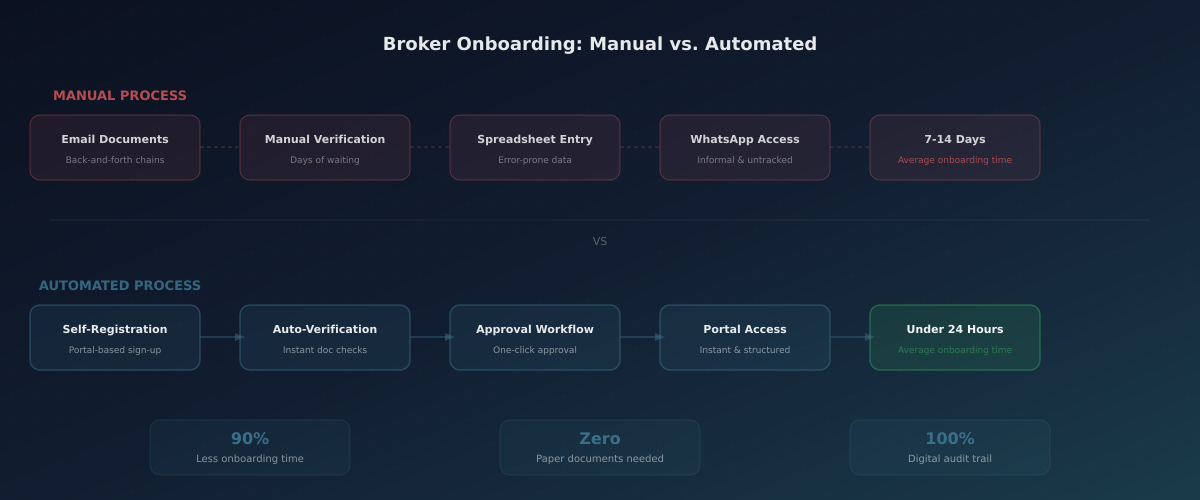 Manual vs. automated broker onboarding — the time difference is dramatic
Benefits of Using Real Estate Broker Management Software
Real estate broker management software addresses each of these challenges by automating processes, centralising data, and creating a single source of truth for developer-broker operations.
Streamlined Onboarding Process
Automated onboarding workflows replace email-based back-and-forth with a structured self-service process. Brokers register through a portal, upload their documents directly into the system, and automated workflows handle verification, approval routing, and access provisioning. What used to take 7-14 days now completes in under 24 hours.
Centralised broker profiles store all licensing, certification, and performance data in one place. Developers can see a broker's RERA registration status, trade license expiry date, active agreements, deal history, and commission balance at a glance — without digging through spreadsheets or emails.
Digital document management eliminates paper entirely. Agreements are generated electronically, signatures are captured digitally, and document statuses are tracked in real time. When a broker needs to renew a trade license, the system notifies them automatically before it expires.
Improved Communication
Single-platform messaging means all communication between developers and brokers flows through one channel. Inquiries, updates, contract changes, and dispute resolution all happen in the same place where the operational data lives — so there is always context attached to every conversation.
Real-time notifications ensure brokers know immediately when new units are released, prices change, commission structures are updated, or their documents need attention. No more relying on WhatsApp broadcasts that get buried in group chats.
Shared visibility into unit availability, booking status, and payment milestones means brokers and developers are always working from the same data. When a unit gets reserved, every broker in the network sees it instantly — reducing stale-information risk; competing reservations and external channels still need explicit controls.
The best broker management platforms do not just send notifications — they create a shared operating environment where brokers and developers see the same real-time data without anyone having to ask.
Enhanced Compliance
Automated compliance tracking monitors every broker's licensing, registration, and contract status continuously. The system flags brokers whose trade licenses are approaching expiry, whose RERA registrations need renewal, or whose agreements are pending signature — and sends automated reminders before deadlines pass.
Regulatory update distribution ensures all brokers receive timely updates about changes in real estate regulations, DLD requirements, or RERA policies. This is especially critical in the UAE, where regulatory updates can affect commission structures, documentation requirements, and transaction processes.
Full audit trails record every action in the system — document uploads, profile updates, approval decisions, commission calculations, and communication records. This protects both developers and brokers in case of disputes and ensures accountability across the entire broker lifecycle.
Key Features to Look for in Broker Management Software
Not all broker management software is built the same. For real estate developers managing broker networks in markets like the UAE, these are the features that separate purpose-built platforms from generic CRM add-ons.
1. Broker Profile and Network Management
The software should provide a comprehensive view of every broker in the developer's network — including company details, individual agent profiles, licensing status, performance metrics, and active agreements. Developers should be able to segment brokers by tier, geography, specialisation, or performance level to target specific groups during project launches.
2. Real-Time Inventory Distribution
When a developer releases new units, changes pricing, updates payment plans, or modifies availability, every broker in the network should see those changes instantly. The right platform eliminates the lag between internal commercial decisions and external market visibility — replacing outdated PDF price lists and WhatsApp broadcasts with a live inventory feed.
3. Commission Tracking and Automation
Commission management is one of the most friction-heavy parts of developer-broker operations. Broker management software should automate commission calculations based on configurable rules — accounting for project type, launch phase, deal milestones, broker tier, and payment schedules. Brokers should be able to see their commission status, payout timelines, and payment history directly in the portal, reducing the back-and-forth that typically bogs down finance teams.
4. RERA and DLD Compliance Management
For UAE-based developers, the platform must natively support RERA broker registration tracking, Form A/B management, DLD documentation requirements, and trade license monitoring. This is not a nice-to-have — it is a regulatory necessity. Generic CRM platforms rarely handle these UAE-specific compliance requirements out of the box.
5. Reporting and Analytics
Developers need dashboards that show broker network health at a glance: active vs. inactive brokers, onboarding pipeline, deal conversion rates, commission liabilities, compliance status, and performance rankings. This data drives decisions about which brokers to invest in, which projects need more broker attention, and where operational bottlenecks exist.
6. Broker Self-Service Portal
Brokers should not need to call or email the developer's team to check unit availability, download brochures, view their commission balance, or update their documents. A self-service portal empowers brokers to operate independently while giving developers full visibility into broker activity without manual oversight.
How Nogbase Solves Broker Management for Developers
Nogbase is built specifically for the developer-to-broker workflow in real estate. Rather than forcing broker operations into a generic CRM pipeline, Nogbase provides a dedicated platform where developers manage their entire broker network — from onboarding to commissions — in one system.
Here is what sets Nogbase apart:
- Centralised broker portal where brokers self-register, upload documents, track inventory, view commissions, and communicate with the developer's team — all in one place
- Automated onboarding workflows that take brokers from registration to active status in hours, not weeks, with built-in document verification and approval routing
- Real-time inventory sync so every broker sees live unit availability, pricing, and payment plans the moment anything changes on the developer side
- Configurable commission automation that handles complex commission structures across multiple projects, phases, and broker tiers — with full transparency for both parties
- RERA and DLD compliance tracking with automated alerts for license expiries, registration renewals, and regulatory changes specific to the UAE market
- AI-powered insights that help both internal sales teams and broker agents identify opportunities, prioritise follow-ups, and close deals faster
This is the same platform approach described in more detail on Nogbase's developer platform page, and it builds on the market trends covered in PropTech UAE 2026.
The developers seeing the fastest results are not adding broker modules to their CRM. They are adopting purpose-built broker management platforms that handle the full lifecycle — onboarding, compliance, inventory, commissions, and communication — natively.
For developers who want to understand how AI enhances these broker workflows, the detailed breakdown is in our post on broker management systems and AI for real estate developers.
The Business Outcome
For developers who move from manual broker management to a dedicated platform, the operational impact is measurable:
- Faster broker activation — onboarding drops from weeks to hours
- Fewer commission disputes — automated calculations and transparent tracking
- Better compliance posture — automated monitoring instead of manual spreadsheet checks
- Higher broker engagement — brokers prioritise developers who give them better tools
- Reduced operational overhead — less manual work for the developer's internal team
- Faster deal velocity — when brokers have real-time data, they sell faster
The developers who modernise this layer now will build stronger broker networks and close deals faster than those still managing relationships through spreadsheets and WhatsApp.
Final Thought
If brokers drive a significant portion of your sales — and for most UAE developers, they do — then broker management is not a back-office function. It is core revenue infrastructure.
Real estate broker management software gives your team the structure to onboard brokers efficiently, keep them compliant, distribute inventory in real time, and manage commissions without the friction that slows deals down.
If you want to see how Nogbase can centralise your broker operations, automate commissions, and give your brokers the tools to sell faster, book a demo.
Related practical guides
Build the next layer with our guides to private inventory sharing and earned, payable and paid commissions.

Keep Reading

Real Estate Document Management Software: Why Developers Need More Than Shared Drives
Learn how real estate document management software helps property developers organise agreements, track licence expiries, support compliance checks, and give brokers instant access to the documents they need.